Summer Fruits Clipart: A Comprehensive Evaluation
Visual assets play a critical role in modern design, particularly when the goal is to evoke specific seasonal themes or moods. Summer Fruits Clipart has emerged as a significant category for designers, crafters, and content creators seeking to incorporate vibrant, organic elements into their projects. This article provides an objective analysis of a specific large summer collection featuring tropical and exotic fruits in a trendy minimal style with botany elements. By examining the technical specifications, stylistic attributes, and practical applications, readers can determine if this resource aligns with their creative requirements.
Defining the Collection and Its Scope
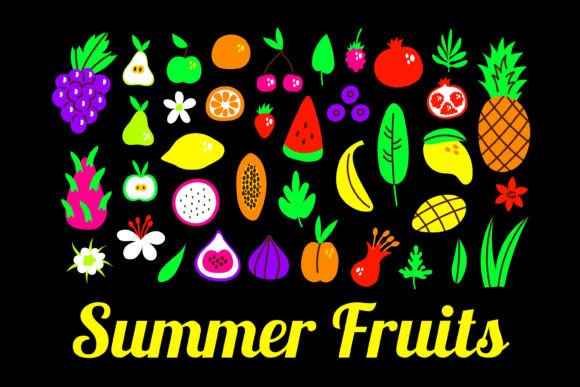
The subject of this evaluation is a digital asset pack centered on a natural botanical set. It features neon-colored, hand-drawn modern shapes of various fruits, including grape, pear, apple, peach, papaya, mango, watermelon, strawberry, raspberry, dragon fruit, fig, lemon, orange, banana, pineapple, pomegranate, cherry, and blueberry. The inclusion of flowers and leaves alongside the fruit creates a cohesive ecosystem rather than isolated icons.
Technically, the collection is delivered as a Zip file containing 38 PNG files with transparent backgrounds, 38 JPG square cards with black backgrounds, and 1 EPS file containing all vector elements. The resolution is specified as RGB high resolution at 300 dpi, with dimensions of 4167 x 4167 pixels. These specifications are substantial for a clipart set, indicating that the images are intended for both high-quality print and detailed digital display.
Why Designers Seek Summer Fruit Assets
Interest in Summer Fruits Clipart typically stems from the need to communicate freshness, vitality, and warmth. In marketing and social media, visual cues associated with summer—such as bright colors and organic textures—are effective at capturing attention during warmer months. For hobbyists engaged in card making, scrapbooking, or decoupage, these assets offer a shortcut to achieving a professional aesthetic without the time investment required for hand-illustration.
The "trendy minimal style" mentioned in the collection description addresses a current design preference where simplicity meets character. Unlike hyper-realistic photography, which can sometimes feel heavy or dated, stylized illustrations allow for greater flexibility in layout and color integration. The addition of botany elements like leaves and flowers further enhances the versatility, allowing users to create borders, backgrounds, or standalone focal points.
Benefits and Technical Advantages
One of the primary benefits of this specific collection is its format diversity. The inclusion of PNG files with transparent backgrounds is essential for overlaying images onto various colored backgrounds without unsightly white boxes. This is particularly useful for website design, food and drink decoration mockups, and T-shirt prints where the background must remain fluid.
The provision of an EPS file adds significant value for professional workflows. EPS (Encapsulated PostScript) is a vector format, meaning the graphics are mathematically defined rather than pixel-based. This allows for infinite scaling without loss of quality. If a designer needs to enlarge a small strawberry icon to the size of a billboard or shrink it for a business card, the EPS file ensures crisp edges and clean lines.
Furthermore, the resolution of 4167 x 4167 pixels at 300 dpi exceeds standard web requirements and meets the threshold for high-end print production. This makes the collection suitable for physical outputs such as book covers, invitations, and home decor items where pixelation would be unacceptable.
Tradeoffs and Considerations
While the collection offers robust technical specs, there are tradeoffs to consider regarding style and color. The description notes "neon colored" hand-drawn shapes. While this fits a "modern" aesthetic, it may not suit every project. Designs requiring muted tones, earthy palettes, or strict corporate branding guidelines might find the neon aspect challenging to integrate without significant editing.
Additionally, the "hand-drawn" nature implies a certain level of imperfection. While this adds charm, it may not align with projects demanding geometric precision or ultra-clean, corporate minimalism. Users should review the sample images to ensure the line weight and shading match their existing brand identity.
Another consideration is the licensing scope. While the text lists numerous uses—from kids crafts to business cards—users must verify the specific license terms included with the download. Some commercial uses, such as reselling the clipart itself or using it on merchandise for sale (like T-shirts), often require an extended license beyond the standard personal use agreement.
Ideal Use Cases
This Summer Fruits Clipart collection is a strong fit for several specific scenarios:
- Social Media Content: The vibrant neon colors and square JPG formats make these assets ready-to-use for Instagram posts, Pinterest pins, and story overlays.
- Digital Scrapbooking and DIY Projects: Crafters can utilize the high-resolution PNGs for digital layouts or print them out for physical scrapbooking and decoupage.
- Event Planning: The tropical theme is ideal for summer parties, baby showers, or birthday invitations where a fun, energetic vibe is desired.
- Web and App Design: Developers can use the transparent PNGs as icons or decorative elements in landing pages related to health, food, or lifestyle.
- Print-on-Demand: With the vector EPS file, designers can scale these fruits for t-shirt prints, tote bags, or stickers without worrying about resolution limits.
When Alternatives May Be Preferable
Despite its strengths, this collection may not be the optimal choice for every situation. If a project requires photorealism, such as a menu for a high-end restaurant showcasing actual produce, a stock photography library would be more appropriate. Similarly, if the design brief calls for a vintage or retro aesthetic, the "neon" and "modern" descriptors suggest this collection might clash with the desired mood.
For users who require extensive customization of individual elements—such as changing the shape of a leaf or altering the internal pattern of a fruit—the raster PNG files will be limiting. In such cases, a subscription to a vector illustration library that offers fully editable layers for each component might provide better long-term value, even if the initial cost is higher.
Practical Decision-Making Insights
Before acquiring this Large summer collection, potential users should assess their workflow capabilities. Do you have software capable of opening and editing EPS files? If you only work in basic photo editors, the vector file may be less useful, though the high-res PNGs will still serve well. Additionally, consider the color palette of your existing projects. If your brand relies on pastels or dark modes, the neon accents might require desaturation or recoloring tools.
Evaluating the quantity versus variety is also key. With 38 distinct files covering a wide range of fruits and botanical elements, the set offers good density. However, if your project focuses solely on citrus fruits, purchasing a specialized citrus-only pack might offer more depth in that specific area.
Ultimately, the decision to use this Summer Fruits Clipart depends on balancing the desire for a trendy, modern aesthetic with the technical needs of the final output. For those needing high-resolution, versatile assets for summer-themed digital and print projects, the combination of vector scalability and raster convenience makes this a compelling option. However, for projects demanding strict realism or specific non-neon color schemes, exploring alternative resources may yield better results.